
Your personal AI companion for everyday wellbeing
Supporting Student Wellbeing Through Evidence-Based Artificial Intelligence
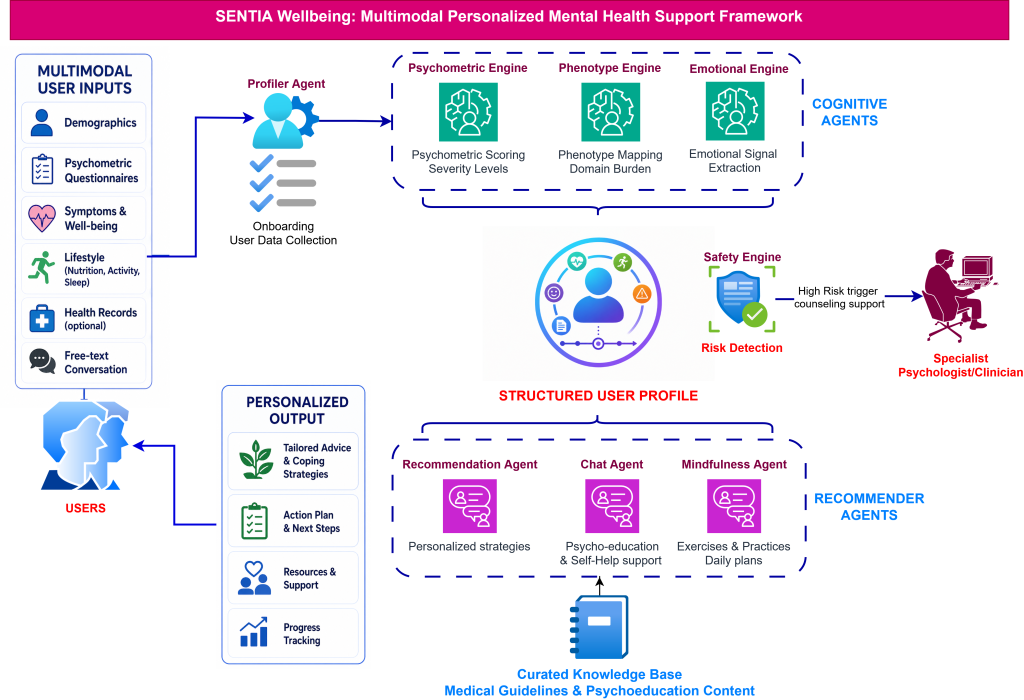
SENTIA Wellbeing for Students is part of the SENTIA Wellbeing project designed to support wellbeing and preventive care through structured, evidence-based monitoring and personalised guidance that includes dedicated applications for students, women’s health, and general wellbeing, alongside advanced specialist dashboards that enable early risk detection, population-level monitoring and more efficient psychological assessment.
SENTIA Wellbeing for Students is assistive, educational and supervised. The app aims to reduce exposure to misinformation, self-diagnosis behaviours, and unverified mental health advice frequently encountered on social media and non-curated websites.
All educational and conversational responses are grounded exclusively in a curated Knowledge Base composed of verified public health guidelines (NICE, WHO, NHS), scientific documentation, and health care approved materials.
The app aims to create a proactive university environment where students can access reliable support, strengthen emotional resilience, and develop healthier academic experiences. Because student success begins with student wellbeing.
What SENTIA Wellbeing Does?
SENTIA Wellbeing provides a safe, confidential, and scientifically grounded environment where students can:
Monitor Emotional Wellbeing and track key indicators related to:
- Stress
- Anxiety
- Sleep quality
- Social anxiety
- Low mood
- Panic
- Academic pressure
Understand Personal Trends
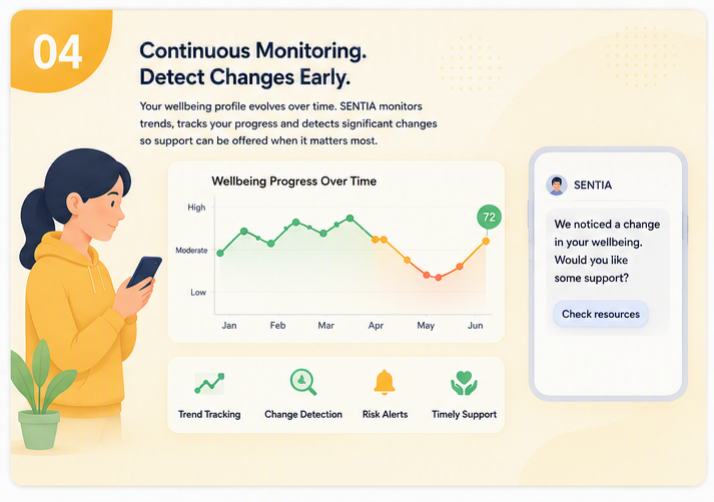
Through longitudinal monitoring, students can visualise how their emotional state evolves over time and identify patterns connected to academic activities and life events.
Receive Personalised Guidance, Recommendations and Self-Help CBT-based interventions based on:
- Individual psychometric assessments
- Academic context
- Identified stressors and triggers
- Historical wellbeing trends
Access Trusted Information
All recommendations are grounded in validated scientific and clinical resources, including guidelines from organisations such as:
- World Health Organisation (WHO)
- National Health Service (NHS)
- National Institute for Health and Care Excellence (NICE)




How it works?
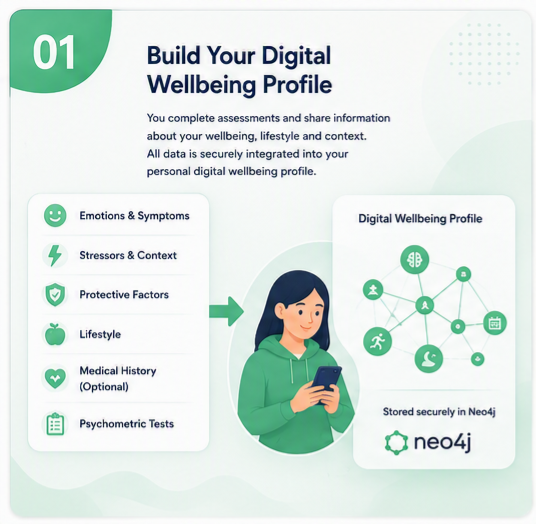
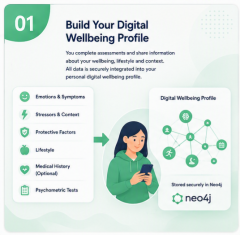
Step 1 – Create Your Digital Wellbeing Profile
Complete a confidential wellbeing assessment including your emotional state, lifestyle, stress factors, academic challenges, protective factors, and validated psychometric questionnaires. Together, these form your personal digital wellbeing profile.
SENTIA integrates internationally recognised instruments, including:
- GAD-7 (Anxiety)
- PSS-10 (Perceived Stress)
- ISI (Insomnia Severity Index)
- SPIN (Social Phobia Inventory)
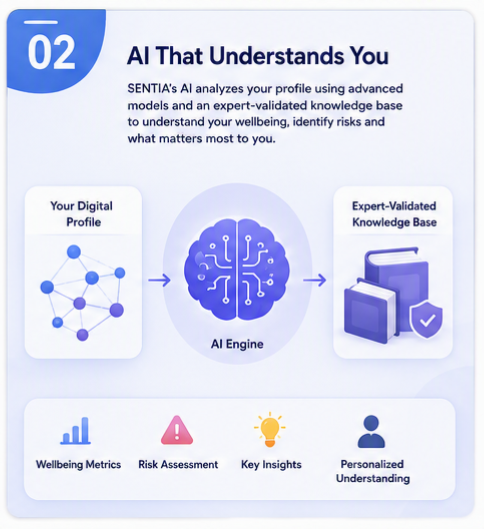
Step 2 – AI Understands Your Context
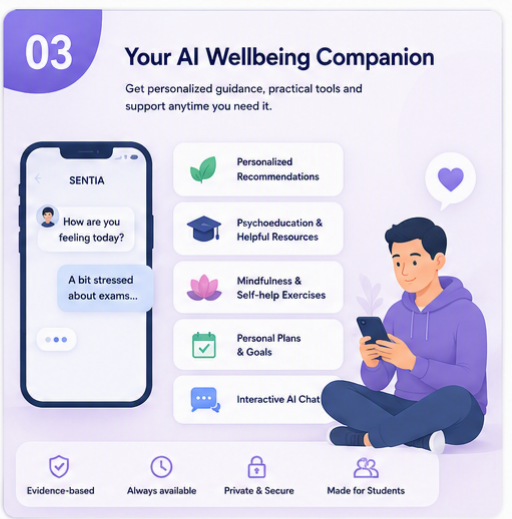
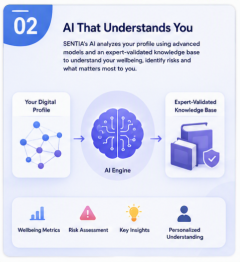
SENTIA uses an AI Couch that analyzes your profile, computes metrics and trends, identifies potential risks without diagnosing, provide recommendations and evidence-based psychological knowledge to understand your current wellbeing. It recommends suitable CBT-informed exercises and personalized self-help pathways based on your profile, assessment outcomes, and current risk level. Activities are user-selected, while pathway progression follows predefined safety rules and periodic reassessment.
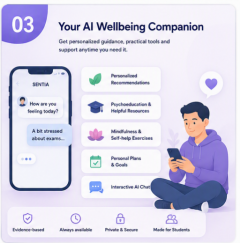
Chat with SENTIA
- AI-powered wellbeing conversations
- Personalized recommendations tailored to your profile
- Evidence-based information and psychoeducational support
CBT-Informed Self-Help Activities
SENTIA offers structured exercises based on Cognitive Behavioral Therapy (CBT), including thought records, cognitive re-framing, behavioural activation, breathing, grounding, relaxation, and goal-setting activities. These tools help you to develop practical coping skills, improve emotional self-regulation, and build healthier everyday habits.
Personalized Self-Help Pathways
SENTIA organizes CBT-informed activities into progressive, personalized pathways addressing anxiety, low mood, panic, and sleep difficulties. Based on validated assessments, individual needs, and progress, you receive structured guidance through manageable stages. Pathway progression is continuously reviewed, with safety rules adapting recommendations and prioritizing professional support when necessary.
Human-Centered Intervention
SENTIA supports communication with university counselling services through Live Chat, ensuring that critical decisions remain under human supervision.
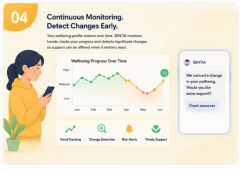
Detect Changes Early
As you continue using SENTIA, your wellbeing profile evolves over time. The system monitors trends, tracks progress, and detects significant changes that may require additional support.
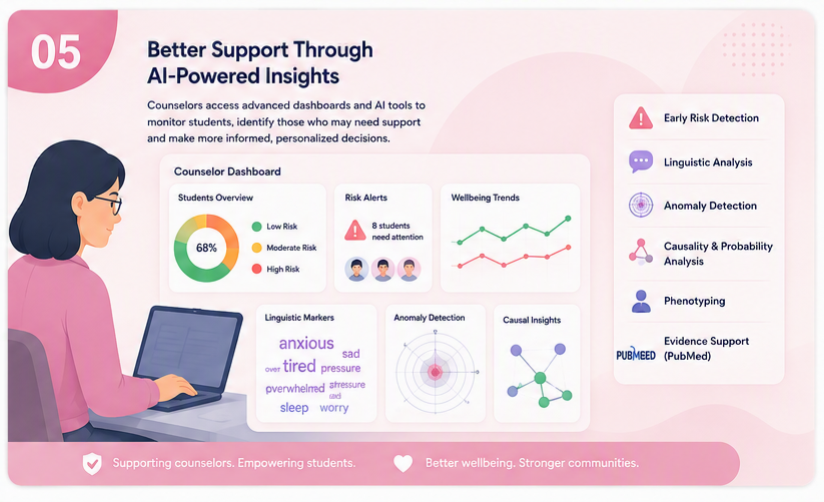
Step 3 – Supporting University Counselors
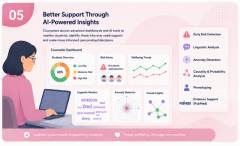
Counselors receive aggregated insights, early warning indicators, linguistic analyses, behavioral trends and evidence-based information to better support students while preserving professional judgment.
Ethical and Safety Boundaries
SENTIA Wellbeing operates under clearly defined clinical and ethical boundaries, ensuring that AI supports, rather than replaces professional judgement. It follows a human-in-the-loop approach where AI serves as a support mechanism rather than an autonomous decision-maker.
It combines AI-assisted psychoeducation and personalized coaching with validated psychometric assessments, deterministic risk stratification, and structured CBT-informed self-help.
SENTIA Wellbeing is explicitly designed as a support system. It does not diagnose, prescribe medication, replace clinical evaluation, or provide emergency decision-making. The AI model is constrained to retrieval from verified documentation and cannot override deterministic risk logic.
Safety mechanisms include structured user state supervision, threshold-based risk classification, escalation protocols for critical cases, and psychologist confirmation requirements for flagged insights. This ensures that artificial intelligence remains assistive rather than authoritative.